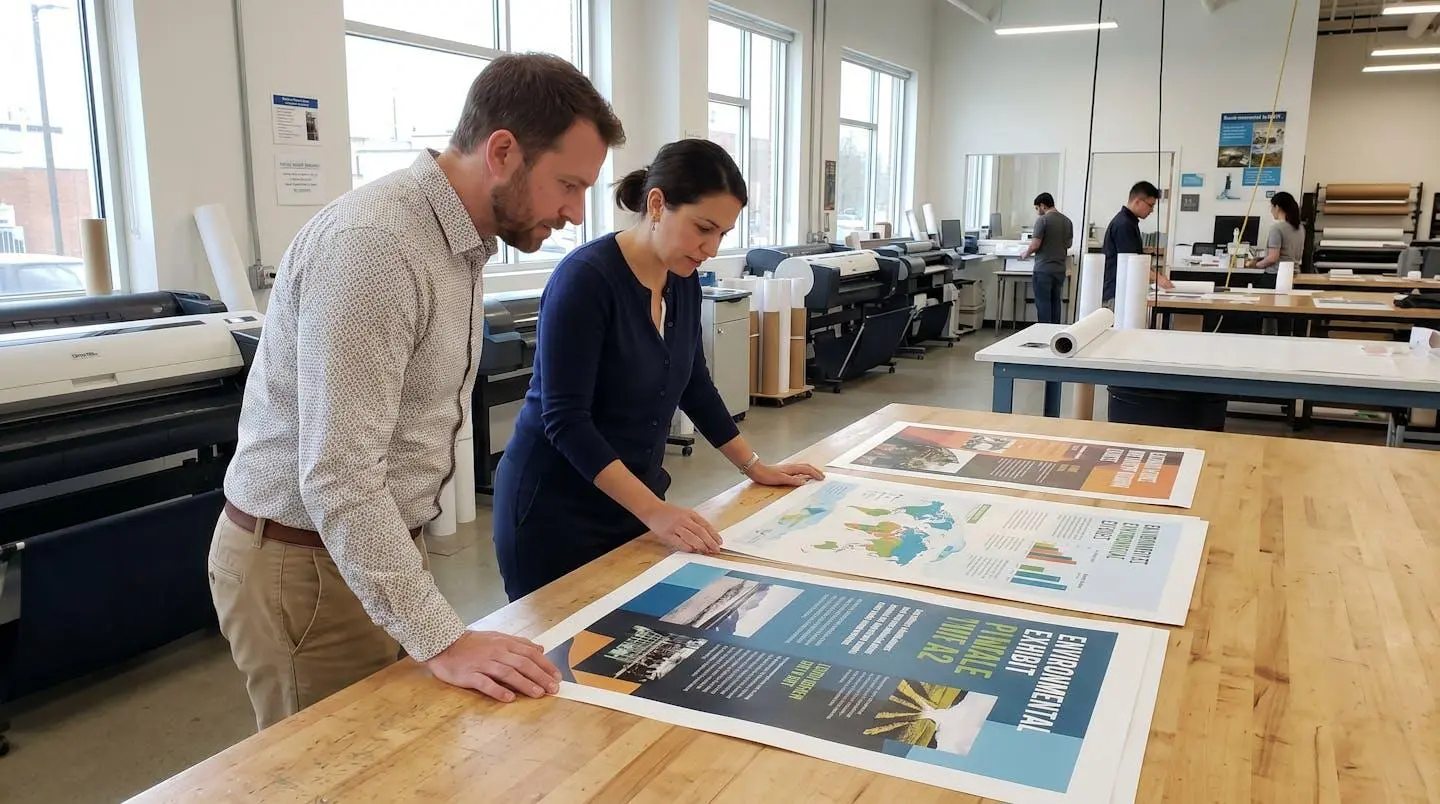
The core distinction comes down to setup infrastructure versus unit flexibility. Screen printing requires creating physical mesh stencils (one per colour) before production begins, generating upfront costs that only make economic sense when spread across larger quantities. Digital printing eliminates setup entirely by applying ink directly from computer files to substrates, making it viable for single-unit orders but more expensive per piece at volume. Both methods deliver professional results for outdoor Calgary signage when proper UV-resistant materials are specified, yet each dominates different applications based purely on project mathematics.
Your quick printing method guide
- Digital printing: Best for 1-250 units, rush orders, photographic designs, and variable data (no setup fees)
- Screen printing: Most economical at 100-250+ units, delivers superior opacity on dark materials, exact Pantone colour matching
- Cost break-even: Setup fees make screen printing more expensive for small runs but dramatically cheaper per unit at volume
- Calgary durability: Both methods achieve 5-7+ year outdoor longevity with proper UV-resistant inks and laminates
How these printing methods actually work (and why it matters)
Understanding the mechanical differences between these technologies clarifies why volume and design complexity drive method selection. Digital printing functions like an office inkjet printer scaled to industrial size — a print head moves across the substrate (vinyl, coroplast, aluminum, fabric) depositing microscopic ink droplets directly from digital files. No physical templates exist between the computer and the finished print. The printer reads your artwork file, calculates colour mixing through CMYK (cyan, magenta, yellow, black) process, and applies ink in a single pass or multiple layers depending on substrate and equipment.
Screen printing operates through a stencil-based process. Technicians create a fine mesh screen for each colour in your design, blocking areas where ink shouldn’t print and leaving open mesh where it should pass through. Ink is forced through the open mesh onto the substrate using a squeegee blade. A two-colour logo requires two separate screens, each aligned precisely. This physical infrastructure represents both the method’s main cost barrier and its volume efficiency advantage.
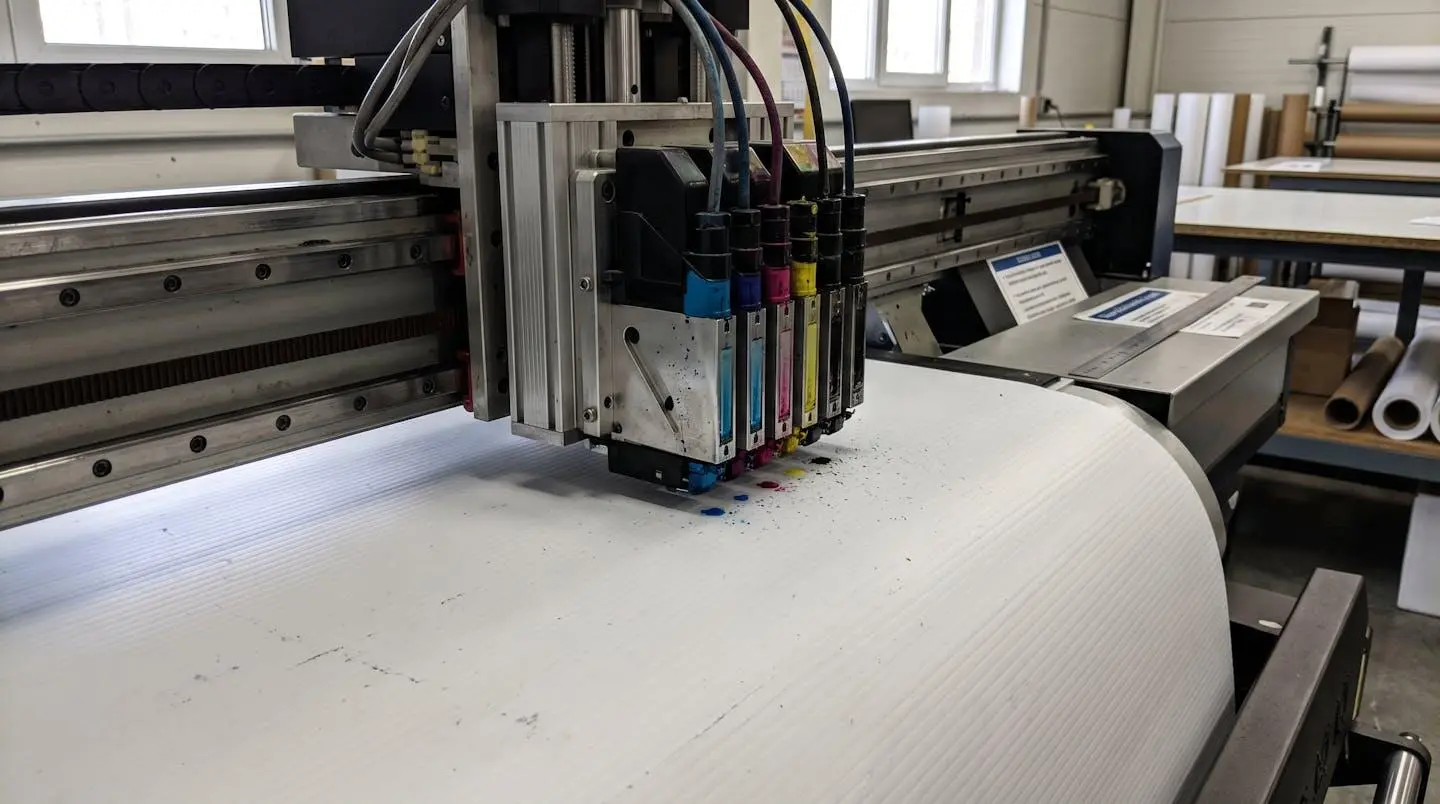
The workflow differences directly impact turnaround time and design flexibility. Digital printing can begin production minutes after receiving approved artwork — no screens to create, no setup beyond loading substrate and calibrating colour profiles. Same-day or next-day completion is standard for many digital jobs. Screen printing requires 2-5 days for screen preparation before production starts, though once screens exist, printing itself proceeds rapidly. Design changes in digital printing cost nothing beyond labour to modify the file; screen printing design changes require creating entirely new screens at full setup cost.
Technical reality: Screen printing can reproduce photographic images and gradients, but each additional colour increases screen costs and registration complexity. Digital printing handles unlimited colours at identical cost, making it the default choice for complex photographic vehicle wraps or promotional graphics requiring colour-rich imagery.
The volume-cost equation: where each method wins
The financial crossover between methods occurs at the quantity where screen printing’s per-unit cost drops below digital printing’s flat rate, despite setup fees. For standard outdoor signage (18″ × 24″ yard signs, simple 1-3 colour designs), this threshold typically falls between 100-250 units depending on design complexity and substrate. A Calgary retail business ordering 50 window decals will pay less per piece with digital printing; that same business expanding to 15 locations needing 300 identical storefront signs reverses the equation in screen printing’s favour. Industry analysis from WhatTheyThink projects screen printing revenue for graphics and packaging at $9.37 billion in 2025, highlighting its niche repositioning as digital technologies dominate short-run signage applications.
Screen printing setup costs in the North American market generally range from 50-150 CAD per screen, with each colour in your design requiring a separate screen. A three-colour logo incurs $150-450 in setup fees before printing the first unit. These fixed costs get amortized across your order quantity: 50 units absorb $3-9 per piece just in setup, while 500 units dilute setup to $0.30-0.90 per piece. Digital printing carries zero setup fees but charges a higher base rate per square foot of printed area. Businesses that work with providers like Bold Signs’ graphics services benefit from accessing both printing methods under one roof, allowing project-by-project optimization rather than being limited to a shop’s single specialty, more detail by clicking on this link.
Digital printing’s market share provides context for understanding its commercial maturity and industry adoption trajectory across North American signage markets. Smithers’ 2025 global print market data confirms digital printing’s growing commercial maturity, with the technology capturing 18.6% of the overall graphic and packaging market by value. Recent industry data quantifies this position:
18.6%
Share of the overall graphic and package printing market held by digital printing technology in 2025
Consider a Calgary franchise operator expanding from 3 to 12 locations. Initially ordering 15 custom outdoor signs via digital printing made sense — fast turnaround, zero setup investment, total flexibility. By location eight, the pattern became clear: each location required nearly identical signage with only address variations. The cumulative spend on digital prints at premium per-unit pricing exceeded what bulk screen printing would have cost by roughly 60%, plus the lost opportunity to lock in exact Pantone colour matching across all locations for brand consistency.
The following breakdown compares seven critical decision factors, showing how each method performs and identifying which project parameter determines the winner for your specific needs. Use the rightmost column to match your situation to the optimal method:
| Factor | Digital Printing | Screen Printing | Winner Depends On |
|---|---|---|---|
| Setup Cost | $0 – No screens or setup required | $50-150+ per colour/screen (one-time per design) | Your order frequency and design changes |
| Unit Cost (Low Volume 1-50) | Most economical – no setup to amortize | Higher per-unit due to setup fees | Your total order quantity |
| Unit Cost (High Volume 250+) | More expensive per piece | Dramatically lower as setup spreads across volume | Your total order quantity |
| Turnaround Time | Same-day to 24-48 hours possible | 3-7 days (screen creation + production) | Your project timeline |
| Colour Complexity | Unlimited colours, gradients, photos (CMYK process) | Each colour adds screen cost; best for 1-4 colours | Your design complexity |
| Colour Matching | CMYK approximation of brand colours | Exact Pantone spot colour mixing | Your brand consistency needs |
| Dark Substrate Performance | Requires white underbase layer; less opaque | Superior opacity; bright colours pop on dark materials | Your substrate colour |
Turnaround urgency can override volume economics entirely. A construction company needing 75 safety signs for a site opening in 48 hours cannot wait for screen production, regardless of per-unit cost savings. Digital printing’s speed advantage becomes the dominant selection factor. Conversely, a real estate agency planning seasonal campaigns three months ahead gains maximum value by committing to screen printing for recurring lawn sign orders, banking the per-unit savings across predictable volume.
Durability, substrates and Calgary’s weather factor
Outdoor signage longevity depends more on material selection and protective coatings than on printing method itself, though each technology has durability characteristics worth understanding. Calgary’s climate presents specific challenges: Calgary’s exceptionally high UV exposure (among the sunniest major Canadian cities), temperature swings from -30°C winter lows to +30°C summer peaks, and rapid freeze-thaw cycles that stress substrate adhesion. Both digital and screen printing can deliver 5-7+ year outdoor performance when specified with UV-resistant inks and protective laminates appropriate to these conditions.
As quantified in the November 2025 Smithers industrial print forecast, screen printing maintains technical advantages for applications requiring opaque coatings, special inks, and high-viscosity fluids — a key differentiator in signage requiring solid colour coverage. Screen printing inks can be layered more heavily than digital inks, creating superior opacity when printing light colours (especially white or yellow) on dark substrates like black aluminum composite or navy blue vinyl. Digital printing on dark backgrounds typically requires a white underbase layer printed first, adding production steps and potential for adhesion issues if substrate preparation isn’t perfect.
Substrate compatibility varies between methods. Digital printing works on virtually any material that can feed through the printer or fit on the flatbed: vinyl, fabric, coroplast, dibond, acrylic, wood, even leather or canvas for specialty applications. Screen printing traditionally favours flat, smooth substrates for optimal ink transfer, though experienced shops can screen print on textured surfaces with technique adjustments. The key advantage of digital printing for custom signage applications lies in its material flexibility — businesses can test identical graphics on multiple substrate types without incurring new setup costs for each material.
A Calgary construction firm ordering permanent outdoor site identification signs might prioritize screen printing for its ink durability and opacity on aluminum composite panels. That same firm ordering temporary promotional banners for a three-month hiring campaign would choose digital printing on vinyl, delivering adequate outdoor durability at fraction of the cost.
- Zero setup costs – economical for small quantities (1-250 units)
- Fast turnaround – same-day or 24-48 hour production possible
- Unlimited colours – photographic images, gradients, complex designs
- Variable data capability – personalize each print (names, numbers, addresses)
- No minimum quantities – order exactly what you need
- Volume economics – dramatically lower per-unit cost at 250+ units
- Exact colour matching – mix precise Pantone spot colours for brand consistency
- Superior opacity – vibrant light colours on dark materials
- Ink durability – certain screen formulations offer exceptional outdoor longevity
- Reorder efficiency – retained screens simplify consistent repeat orders
The evolution of digital printing technology has narrowed historical quality gaps. Early digital prints faded noticeably faster than screen prints in outdoor applications, but modern eco-solvent, latex, and UV-cured digital inks achieve comparable outdoor durability when paired with appropriate laminates. The relationship between the importance of marketing for businesses and signage investment becomes clear here: underspending on protective materials to hit a lower price point delivers poor ROI when signs require replacement in two years instead of six, multiplying long-term costs and damaging brand perception through faded, weathered signage.
Matching your project to the right method
Selecting the optimal printing method requires evaluating your project across four primary decision factors: total quantity (including likely reorders), timeline urgency, design complexity, and brand colour precision requirements. Most signage purchasing mistakes stem from optimizing for a single factor while ignoring how the others interact. A business fixated on per-unit cost alone might choose screen printing for a 200-unit order, overlooking that their design contains photographic imagery requiring five-colour separation — a scenario where digital printing’s unlimited colour capability delivers better value despite higher unit pricing.
- What’s your total order quantity (including probable reorders)?
1-100 units: Digital printing — Zero setup costs and fast turnaround make digital ideal for low-volume orders, even if you plan identical reorders later (each reorder starts from saved files with no new setup).
100-250 units: Get quotes for both methods. Simple designs (1-3 solid colours) may justify screen printing setup; complex designs (photos, gradients, 4+ colours) favour digital economics.
250+ units: Screen printing — Setup costs are fully amortized across volume, delivering lowest per-unit price. This advantage grows exponentially above 500 units. - What’s your realistic production timeline?
Need it in 24-72 hours: Digital printing exclusively — Screen creation requires minimum 2-5 days before production begins.
Timeline allows 1-2 weeks: Both methods viable; evaluate based on other factors (volume, cost, quality needs).
Planning 3+ weeks ahead: Timeline constraints removed; optimize for volume economics and quality requirements. - How complex is your design?
Simple (1-3 solid colours, logo/text only): Both methods work well; decide based on volume and timeline.
Complex (photographic images, gradients, 4+ colours): Digital printing — Multi-colour designs incur per-colour screen setup fees that quickly exceed digital printing’s flat rate.
Printing on dark substrates (black, navy, dark grey): Screen printing advantage — Superior ink opacity for light colours on dark backgrounds, though digital can work with white underbase techniques. - Do you require exact Pantone brand colour matching?
Exact brand colour match critical (franchise consistency, strict brand guidelines): Screen printing — Allows mixing precise Pantone spot colours that remain identical across all units and reorders.
Close colour approximation acceptable: Digital printing — CMYK process achieves very close colour matching for most applications, with minor batch-to-batch variations possible.
Multi-location brand consistency across hundreds of signs: Screen printing’s spot colour advantage becomes decisive for maintaining uniform appearance.
A Calgary food truck operator updating menu offerings seasonally needs signage that can change quickly without financial penalty. Digital printing’s zero-change-cost model suits businesses with evolving messaging. Conversely, a contractor operating a fleet with static branding benefits from screen printing’s volume economics and exact colour matching.
Beyond these decision factors, obtaining itemized quotes from experienced Calgary providers for both methods remains essential before committing. Quotes reveal substrate-specific cost variations and timeline realities that generic volume thresholds cannot predict.
- Calculate your total order quantity, including likely reorders of identical designs over the next 12-24 months
- Count the number of distinct colours in your design (each colour equals one screen in screen printing)
- Determine your realistic timeline — factor in artwork approval time, not just production speed
- Identify your substrate colour (dark materials favour screen printing’s superior opacity)
- Clarify brand colour requirements (exact Pantone match needed, or CMYK approximation acceptable)
- Assess likelihood of design changes (frequent updates favour digital’s zero-change-cost model)
- Request itemized quotes for BOTH methods from experienced Calgary shops before committing
- Verify outdoor durability specifications (UV-resistant inks and protective laminates) regardless of printing method
Signage decisions fit within broader promotional strategy and budget allocation frameworks. Businesses developing comprehensive marketing plans benefit from understanding how the 7Ps of the marketing mix interact with physical presence investments like signage — aligning printing method selection with overall brand positioning, distribution strategy, and promotional consistency across channels rather than treating signs as isolated tactical purchases.
Rather than asking which printing technology is superior, experienced Calgary businesses ask which method suits each specific project. The operators who optimize signage spending maintain relationships with providers offering both capabilities, selecting digital for rush jobs and evolving campaigns while leveraging screen printing’s volume economics for permanent installations and recurring orders. That project-by-project flexibility — not loyalty to a single technology — delivers the best long-term value across your complete signage portfolio.